
FR. BARRY SUMMER HOMILY
Scriptures Romans 5 verses: “Christ, while we were still helpless, died at the appointed time for the ungodly. Indeed, only with difficulty does one die for a just person, though perhaps for a good person one might even find courage to die. But God proves his love for us in that while we (all) were still sinners– Christ died for us! How much more then, since we are now justified by his blood, will we be saved through him from the wrath.” Mark 10 Jesus sent out these twelve after instructing them thus,
“Go (forth) to the lost sheep of the house of Israel. As you go, make this proclamation: ‘The kingdom of heaven is at hand.
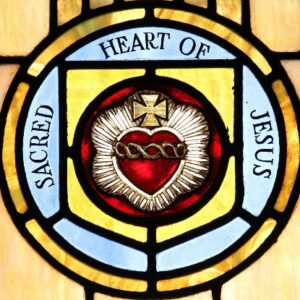 It is good that SomeOne out there loves all of humankind perfectly. It is God, and it by His Spirit, and it is in Jesus, and the Son of God Who became man does love us wondrously so from His Sacred Heart.
All of June is Sacred Heart month. It’s a full 30 days for us to ponder this Love Mystery. The Sacred Heart of Jesus fully loves humankind. To be clear, He loves humankind, but God in Christ does not love humankind’s sin. It’s not a month to celebrate sin—nor is any month—but June is a time to dwell upon the wondrous Perfect Love of God and to give devotion to the Sacred Divine Heart of Jesus Christ. He has remedy for sin via His Innocent Heart, so pierced for sinners that they might be saved. Look into this devotion if you know it not.
Romans chapter 5 is such a timely reading on this Sunday right after the Sacred Heart feast on Friday. It has a few verses we heard proclaimed today that marvel at how we poor sinners we’re still so loved by God to move us onto salvation. Listen to verse 6: “Christ, while we were still helpless, yet died at the appointed time for the ungodly.” Interpretation: Christ the Lord—that’s Jesus, the One of the Sacred Heart—–verse 6: “while we were still helpless” —interpretation: that’s right, while we were stuck gravely in our prideful sin, severely needing much help, because we could not help nor save ourselves—verse 6: yet (or still) even died for the ungodly. Interpretation: Who did? Jesus did. Jesus had this heart that loved us in this world, even while we offended God willfully or ignored Him purposefully—we, the ungodly! (That’s not a nice term to be dubbed with—but it fit us.) What did Jesus do for the ungodly lot of us?—Verse 6: He died at an appointed time. Interpretation: So what’s this verse saying? That Jesus had a plan and an appointed time to full-heartedly love us poor sinners His love involved a death on The Cross.
In the gospel of John chapter 19: 33-34 But when the soldiers came to Jesus and saw that he was already dead, they did not break his legs, but one soldier thrust his lance into Jesus’ side, and immediately blood and water flowed out. John 19, Verse 37 And prophetic passages (in Numbers and Zechariah) were fulfilled, that “they will look upon Him who they have pierced.” (Upon the Lord Son of David, and on the same Lord Who led Moses, with a healing on a pole miracle.).
Romans 5 verse 7 asks ‘Who would die for an enemy, an ungodly undeserving one? Who even would die for a friend?’
Yet Romans 5:verse 8 answers it that there IS SomeOne Who would love all of needy humanity like that, giving up themselves in a victimhood of love, in a loving sacrifice of love, and in a Total Giving of Self– even to the point of dying for us Verse 8 But God proves his love for us in that while we were still sinners Christ died for us.
What follows in the epistle text is this: Verse 9 Now justified by His blood, will we be saved through Him from the wrath. Interpretation: God has proved a point of love. He went to the point of death to save you from the wrath of sin. Sin can separate us from God forever. Wrath even sounds too pleasant a word for that situation. Damnation fits. To save the sinner from damnation, it took our saving by Jesus’ Body and Blood.
Romans 5:11 then names what is offered us: reconciliation. You make peace and friendship with God, deeply, and it’s a Heart-to-heart love of God and His people evermore.
Use all these Romans 5 words and put them together and it speaks of what we have from The Sacred Heart of Jesus! There is the Perfect Love in Jesus to save the world. There is a dearest outreach to use for coming Home to God. Let us turn to Him. Let us ponder the Word made flesh Jesus, Who took to Himself a human heart in His Messianic conception to birth.
I would like to remind you that the Sacred Heart began beating in the body of Jesus in the womb of Mary. The concept of the “embryonic” or “tiny” Sacred Heart is often reflected upon in our Catholic spirituality to emphasize the humanity of Christ and the sanctity of life from its earliest stages. The traditional Litany of the Sacred Heart indeed holds the prayer: “Heart of Jesus, formed by the Holy Spirit in the womb of the Virgin Mother, pray for us. The papal encyclical Haurietis Aquas affirms that from the His conception time, the Savior’s heart was formed and beat with a love that was both fully human and fully divine. He started with loving the infant in the womb, by being one Himself in tiny heartbeats. He’d later say as a adult: Let the little children come unto Me….and whatever you do to the least of these, You do unto Me. For divinity has gone through the human birth process—making it sacred. Be pro-life, Catholics! As the US bishops consecrated America to the Sacred Heart of Jesus for her Semiquincentennial of on this July 4th—remember the Jesu Baby heartbeat at Bethlehem who loved us.
How more so do we ponder the Sacred Heart? Primarily as the One Heart to help us overcome the peril of sin and death. Maybe secondly as the One Heart to wonder of how much really has been poured out from Jesus, and then, what has been our heart’s response? Maybe thirdly, can we think of our own shortcomings of love, or falls in fear, and look to how we can better pair with the Sacred Heart of Jesus. He can help us—Heart to heart. Those are some applications.
You could just look to what St. Margaret Mary Alacoque revealed from her mystical seeing of the Christ’ Sacred Heart, which urged her in the 1670’s to spread a devotion to Jesus’ love by it, which Jesuit missionaries would bring to America, such us to Maryland. What are the four things of the image? First, you see the Heart itself—to remind us of the infinite, passionate love of God taking on a beating, human form. This fulfilled the Ezekiel prophecies of God loving us from the Heart and providing us a new heart within. Looking at the Heart reminds the faithful that Jesus shared in every human joy, tear, and physical ache with us. Now, in His Risen, Ascended and Glorified Life as God/man and Mediator to the Trinity, Jesus shares His heart of love into a merging of ours. Secondly, in the Image, The Crown of Thorns is wrapped around the heart. It symbolizes the painful reality of sin, human rejection, and the mental and physical agony Christ willingly endured for humanity’s salvation. His Head was crowned in mockery of His so-called King of the Jews identity, but now he wears the thorns to His heart showing how indeed He was the Word made flesh (with a human heart now) that took on the scorn of people. It still takes on scorn, from those who think sin and pride are no big deal. But the Holy Offering has been made. Our Holy Mass honors it. The third aspect to the image of The Sacred Heart is the Wound and the Flames: The spear piercing His side represents the total outpouring of Self, (Saint and Pope John Paul II called it Jesus’ Totus Tuus), while the flames or fire represents the burning, passionate love of God that seeks to melt our hearts and inspire devotion. The fourth and final aspect of the Image is the Blood and Water: Reminiscent of the Apostle John’s written messages, these symbolize the sacraments of the Church (Eucharist and Baptism) and the cleansing flow of grace and mercy pouring from Jesus’ pierced side. The Sacrament promised in Jesus’ Last Supper intention now comes upon the altar in a true Presence—Jesus death at Calvary was no symbolic act- it was real and it is re-presented via History from that Heart that still is giving, Who was loving us at that Last Supper and every Mass henceforth.