
TAKE HIS YOKE UPON YOUR SHOULDERS

FOR I AM…………….”MEEK AND GENTLE OF HEART.”
I GIVE REST AND TRANQUILITY TO YOU…WHO ARE YOKED TO ME.
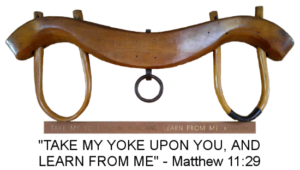
“Come to me, all you who labor and are burdened, and I will give you rest. Take my yoke upon you and learn from me, for I am meek and humble of heart; and you will find rest for yourselves. For my yoke is easy, and my burden light.”
When Jesus says for us to “take His yoke upon our shoulders,” He means for his disciples to share in the work of spreading the Gospel and the Kingdom of God. That is like His image of two oxen working side by side to pull the plow. The fields are His harvest of souls “field,” and it is where we can help in the work. Jesus says that “My yoke is easy and my burden light.” This means that Jesus is still doing the main work, or heavy lifting, in the Good News going forth. We have an expected helper role; it’s not the heavier pull—that would be the Lord’s part.
That’s not to say our part is real easy. No. It just is in comparison to what God is doing in the partnership of plowing the fields of harvest. Disciples of Jesus must know that we are working with Jesus, and it is His mission we devotedly serve.
We surely have had some evangelizer-missionaries in the USA who have taken on hard tasks, but they did them, for advance of The Gospel—knowing that the Lord was with them. Let me share two of their stories, both ones coming from USA’s Midwest. I think they’re a couple of good stories to tell on our Fourth of July time.
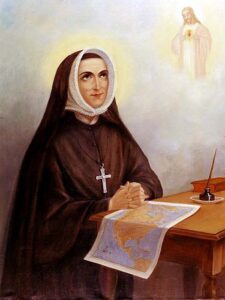
St. Rose Philippine Duchesne was a French-born missionary who courageously traveled to the American frontier in the 1800’s, working mostly among Native American communities in today’s middle America. In the year 1776, she was still then a student of the Visitation Religious sisters in France, but by 1818 was a religious sister responding to a bishop’s request to come to his massive diocese of Louisiana with its see in St. Louis (Bp. William DuBourg). She would serve in mission life in middle America unto her 1852 death. Sister Rose was sent today’s Kansas/Missouri region. She was to found some academies. At first her task was to help evangelize the Indian and French children of his region. At St. Charles, near St. Louis, Rose Duschesne founded the first house of her religious order outside of France. It was in a log cabin- and with it came all the austerities of frontier life: extreme cold, hard work, lack of funds. She also had difficulty learning English and the local languages. Eventually, she began The Sisters of The Holy Cross in America. They opened the first free school west of the Mississippi River. By 1828, Rose had founded six religious houses for the young Catholic women of Missouri and down the river to Louisiana. In her later years of service, she had lived at the Potawatomi School at Sugar Creek, Kansas, encouraging the school while being in declining strength. They named her Sister Quah-hah-ka-num (The Woman Who Prays). Rose died at 83 years age of life, and rests in St. Charles Missouri. I visited that resting place in June of 1988, and on July 3, 1988 Rose was canonized.
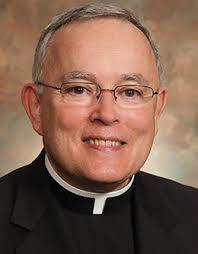
Speaking of Potawatomi Catholics, and of Kansas and Missouri, I first met Capuchin Fr. Charles J. Chaput in 1983. He was a vocation from the Prairee Land Potawatomi Tribe and would later become the first bishop and Archbishop of Native American lines in the USA. Since he was Capuchin Franciscan priest, it was not a surprise that he visited St. Charles Borromeo Seminary in Cleveland, where I was in 83-84, as they had Capuchin teachers and students mingled in there along with the Cleveland and Washington DC men. Chaput came and stayed for some days and shared his testimony with us. He was 39 of age then. I was struck by his boyish demeanor, or child-like faith and innocence, and of his courtesy and deference to others, and of his solid faith upbringing. He shared of being from parents of large families, continuing the legacy of family Catholicism, brought to them once by mission religious to the territories and further sustained. He shared how important the work of evangelism is in America, with him being a product of “being seeded with good faith in good ground,” as he put it. He talked about his following of St. Francis as a Capuchin. Since then, I have been impressed with Chaput as one of our great US Catholics.
1n 1988, I was ordained, along with others of Mt. St. Mary’s Seminary, where I did my theology studies. We had seminarians from places like Rapid City, South Dakota. I had gone out to that area of South Dakota with my classmate Fr. Bryan. He was assigned to the Rapid City Cathedral and to serve under its new bishop, Charles Chaput. Bryan thought that was great, since Rapid City was a diocese that served several reservations, so that he could be an inspiration to them. Chaput was obviously proud of his Potawatomi Native American heritage without wearing his roots, so to speak, on his sleeve. Moreover, his striking modesty and gentleness exemplified the Franciscan vocation he had first embraced. Here, I thought, was a great shepherd for that diocese, living out the meaning of his episcopal motto, “As Christ loved the Church.” Chaput was a down-to-earth and somewhat fun priest and bishop. He also was unabashedly Catholic. In a time with a growing wokeness in America, and too much compromise for Christianity to immoral things or downplaying the Lordship of Jesus, Chaput stood ground on the good faith upbringing of his childhood and adulthood. He did so not sternly, but lovingly, and kept quite an approachable way about him. South Dakota welcomed him. I then next met Chaput in person when staying in his Cathedral rectory in Denver, which was his second bishop assignment. He had taken Cardinal Stafford’s place, right after the Denver Youth Day time, and I was impressed by the alive faith in the city—different from the quieter church in the 1980’s on an earlier visit. I was told I could stay and eat in the Cathedral for free, as long as I would hear daily confessions in the morning. That seemed easy enough. Yet in the church, there were dozens in line every day for the sacrament! The Cathedral was a young adult hub of Catholic activity, and for devoutness to the Faith, with great Catholic teaching going on. It was much due to Chaput. Chaput was always holding it important for people to know their Catholic Faith, and to gather together in it, and to evangelize the city and area. Foccus started there, and St. Augustine Institute. The bishop’s zeal was catchy. He was still the young-at-heart, down-to-earth believer and follower of St. Francis’ Way, but now as a diocesan bishop. He was available to meet people a lot—accessible, even via email—which he liked to use.
Chaput’s example in the US church (and to fellow apostles) was to be an evangelical Catholic and outgoing presence for the Faith. In many people’s judgment, the premier New Evangelization diocese in the country was his. But he governed the Denver church in a genuinely collegial manner, which is one reason he drew many highly talented lay collaborators to come to Denver. He was joyous for the Church’s growth in the Mile High City; he would have happily spent the rest of his life there. However, he was asked by Pope Benedict to move to be the bishop of Philadelphia in a time of crisis there. In 2011, their Archdiocese was in grave trouble, and Archbishop Chaput accepted the unenviable task of fixing what had become a serious mess, financially and otherwise. He turned the Philadelphia situation around—and even then hosted Pope Francis’s highly successful visit in 2015. The Philly Church was perhaps once the most Catholic city in America, but not when Chaput came to it. He had to make decisions that were problems passed down to him. Yet this bishop still communicated that it was the life of Philly’s souls who were his greatest concern; a church rocked by falling numbers and amid a growing climate of secular humanism and heavy spirit of compromise to immoral lifestyles that had taken the city and area. Chaput preached Christ and His Truth with his same zeal as ever, but was met with all sorts of opposition from marginalized Catholics and non-Catholics and the media who did not want the Light of Truth shining down onto their situations. His pro-life and pro-marriage and family message was spot on. It rattled the fence sitters. I can’t say that I ever met a bishop or priest so mistreated and maligned as Chaput, as in those years in Philly—but he remained smiling and caring, while also tough-skinned. His Excellency has never fought tooth-for-tooth with his critics, nor be in any retal-iatory manner. Instead, he has held unconditional love about him. It gives him a dignity, remaining into his retirement, which is left for his bishop successors to note as spiritual and pastoral qualities to embody. Chaput is a kind man, for anyone who has come to meet him. He also likes to teach through writing. He has written some works. One of them is of how he thinks we are to live amidst an increasingly secular humanism. It’s in a book called Strangers in a Strange Land: Living the Catholic Faith in a Post-Christian World (Holt). He knows that the United States is living through a season of profound moral and cultural turbulence—turbulence that threatens to unravel the American democratic experiment. The archbishop writes; The Word of God testifies to the goodness of creation, the gift that is life, and the glory of the human person. With this glory comes a duty. We are born for the City of God. The road home leads through the City of Man. So we are strangers in a strange land, yes. But what we do here makes all the difference.
While seeing all sorts of watered down Christianity, and many independent churches popping up with their new ways, or with Catholics asking their shepherds for compromise to our morals or teachings—we know it’s a time needed for clear leadership and teaching. Chaput answered that call—but in it he knew it would ask him to live the last Beatitude of Christ to His apostles: “Blessed are you, who suffer persecution for My Name and the Gospel’s sake, yours is the Kingdom of Heaven. “ Chaput is retired now from Philly, yet his great example lives on.
To conclude my salute to Duschesne and Chaput, we remember what we heard in last Sunday’s gospel to be true disciples and to take up our cross and follow Jesus: we have these two mid-Westerner Americans that did it—coming forth even from the Potawatomi Peoples. These are two Americans of different times also demonstrate how they knew that the life for the Gospel of Christ that they lived was not such a ‘burden’ or ‘hardship’ on them—for Christ says in today’s gospel that He carries the heavy part. Yours is the lighter load, but if you would but join up with the Lord Who is Meek and Humble of Heart, He’ll give tranquility and rest to your souls. In our Independence Day weekend 2026, I thought I’d point out these two lives who lived this gospel you hear proclaimed in our Summer Sundays. ###
Post-Thoughts In today’s Gospel, Jesus says that our Gospel witness is yoked to Him, Who leads it in America, for His yoke is easy and burden is light. Jesus does the heavy burden carrying, in this trying time of being Catholic, but He wants us walking beside Him as a co-witness, as a child of the Light in Him, to be shining bright in truth amid the darkness. It’s the best thing you can do as an American. The first-ever American bishop of Native American blood, Charles Chaput, did come from a history of Catholics remaining faithful in his family and tribal tree, against the odds. He stayed meek and humble of heart, as remaining close to Jesus all of his life. The 1988 named saint, Rose Duschesne, is a likewise great example for our understanding that each believer is a sent-person by our Lord to go forth and live the Good News and to invite anew people into the His Church. We don’t have to be going 4400 miles to do so as a missionary, like her, but to just be a missionary disciple of where we are. ### One more thing—be welcoming of the foreign or “different” Catholic come to worship with us here.
For further reading of Chaput, see Weigel’s article:
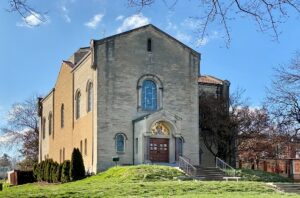
Below: Duschesne house and saint’s drawing. I visited Duschesne’s St. Charles church/house in 1988, a month before her canonization.
https://www.georgeweigel.com/archbishop-chaput-the-best-diocesan-bishop-of ourtime/?