FOR MEDITATION FOR THE LAY MINISTER Scriptures of Sunday:
1 Cor. 10/ The cup of blessing that we bless, is it not a participation in the blood of Christ?
The bread that we break, is it not a participation in the body of Christ? Because the loaf of bread is one, we, though many, are one body, for we all partake of the one loaf.
John 6/ Jesus said to the Jewish crowds:”I am the living bread that came down from heaven; whoever eats this bread will live forever; and the bread that I will give is my flesh for the life of the world.”
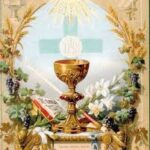
Happy Corpus Christi Feast! It’s a Day to Talk of the Lord Jesus as Eucharist. The Catholic Church teaches that the bread and wine offered at Mass become, by the power of the Holy Spirit, the Body, Blood, Soul and Divinity of Jesus Christ. In other words, the Eucharist IS Jesus. It is all of Jesus. It is nothing but Jesus. It is not a symbol of Jesus. It is not bread and wine along with Jesus. It is Jesus. It is truly Christ on the altar. It is truly Christ given to us in Communion.
This is not a doctrine that has developed over time, but something that lies at the very heart of our faith and at its very start. Jesus said at the Last Supper: This is My Body—(as He held up the bread)—and This is the Cup of My Blood—(as He held up the chalice). We call this His making of a New Covenant, enacted with His very Body and Blood. Jesus gives all. This act is total offering! It is to be joined to what He did or gave at the Cross and by His Resurrection. It is a complete act—so much so, that on Holy Thursday to Easter we have one long continuous liturgy (in three parts) to show how they are all part of One Gift by Jesus.
Celebration of the Eucharist is at the heart of our worship of God as Catholics. It was described in the Vatican II liturgy documents as The source and summit of faith. It is at the center of all we believe. The offering of Jesus to the Father is what we participate in by our prayer. His eternal offering as Lamb of God is what we invoke in our best prayers, in The Mass. In his first letter to the Corinthians, chapter 10, St. Paul emphatically asks: The cup of blessing that we bless, is it not a participation in the blood of Christ? The bread that we break, is it not a participation in the body of Christ? Here he was speaking of the liturgy of that local church in Greece.
It was so important that they did the Mass and did it right, that Paul adds in the next chapter of his letter, that those who profane the Eucharist profane “the body and blood of the Lord” (1 Cor 11:27). This is the apostolic foundation of Holy Mass and its needed reverence. Because of it, Catholics have learned how they are to be receiving the Eucharist “worthily” though they may wonder what that means.
It means to receive Jesus in a state of being free of mortal sin. If you are in one, or more, such sins—then you need Confession to address your situation with God. The Sacrament of Reconciliation gives grace to believers to be restored from have fallen into such a poor state of sin.
One common mortal sin today is fornication or adultery, or being in intimate relations while outside of a holy marriage union. It needs confession. It’s serious. You can’t be living together in sin and then just casually come up for Communion. It needs the attention of the Church, with her Sacrament of Confession, and sometimes with her authority to judge people’s situations, they need to look into who is not married in the Church and for what reason, and a look into whether if an annulment is needed with the apostolic authority invoked to dissolve a bond. Sometimes people have to be annulled of former unions as so to be free for living together and marriage in the Church. I do those cases—a few a year. A couple emailed me last Monday in notifying me that they got married in the Church. They thanked me for assisting them. I got a wedding photo of them sent to me.
Lord Have Mercy, Christ Have Mercy, Lord Have Mercy. For venial sin, of the lesser kind of offense to God, this is presented to The Lord in the Kyrie Rite, near the 2nd minute of Mass. We confess in three times of our need of the Lord’s Mercy, and then the priest gives an absolution prayer. He then declares to all: May Almighty God have mercy on us, forgive us our sins, and bring us to everlasting life.” You say: Amen. You have just presented your venial sins to God’s Mercy.
This important action of Mercy at the start of Mass makes it vital for you to arrive on time, so as not to miss it. It helps you receive the Eucharist in this Mass as most worthily to God. (There is a Lamb of God plea later in Mass, but not an absolution)
In another comment on receiving worthily, in that same 1st Corinthians letter, Paul calls out the rich people of Corinth who have separated themselves from the people of lesser wealth or name. They want an earlier separate liturgy, but Paul says that they are ruining the Breaking of the Bread rite by doing it so that way. All shall be together and receive together in a Mass. The Eucharist is meant for unity.
Next topic: Eucharist is fitting for Sunday.
Sunday is the Lord’s Day, and it is fitting to honor the 4th Commandment by praying at Mass on it, or in its vigil time. Sunday is the first day of the week, and we begin it with The Lord. In a phrase or term that gets misused a bit, the “weekend” does not actually include Sunday. The week’s end is Friday and of Saturday into its afternoon. Sunday begins a new week, so it’s not anymore the week-end. It’s the Week Start. ☺ We start with the Lord leading us into a new week at Sunday Mass, or if needed, at the vigil—borrowing the Jewish practice of the Friday eve as the Lord’s Day vigil. Yet for Catholics, we believe that a new start happened at Easter, making its Sunday a new day, a new experience of faith for eternal life. We have the Week Start with Communion in the Lord Jesus.
Catholics believe that receiving Jesus is truly present in the Eucharist, and it fulfills one of His dearest promises that He would “be with us always.” (Said at the final moment before His Ascension.)
At the Last Supper, when Jesus says, “this is my body” and “this is my blood,” we know He alone has the power to make His words true. We believe in the Eucharist because we believe in Jesus. There it is—a simple, direct reason for Catholic Faith.
Every Week-Start can get off to a good beginning with receiving Jesus anew.
Now a word of posture and ways to receive Holy Eucharist.
If you receive standing, you should first genuflect or make a bow as a sign of reverence; and do so right before your turn. By the way, if one receives when kneeling, then the early gesture is not required. The norm for Eucharist receiving in this nation, as said by our US bishop’s conference, is for standing, but kneeling can be done. It’s not a better or holier posture, though. The main thing is to approach the Eucharist with reverence. The clergy or lay communion minister will hold the host up and say, “The Body of Christ,” to which you reply “Amen.” It is important that you say this. “Amen” is a word of affirmation. It means “it is true.” Your “Amen” says that you understand that what you are receiving is not ordinary bread but the Body of Christ. The minister of communion needs to hear you say this. If you are also receiving of the Cup of the Blood of Christ at a Mass, then you will hear said: “The Blood of Christ,” to which you reply “Amen” to again.
For most of all the years of my Church life, The Church has permitted reception of Eucharist on the hand, but it has also said, then, that the host of Christ must be consumed immediately, in front of the minister. Not taken away from the Communion reception spot. If one does, then the minister may call you back!
After you receive the host, if you desire, you may also receive from the chalice. We offer it at most Sunday Masses. It is optional, but one must be standing for it. One may not take a Eucharist host, and dip it yourself into the Precious Blood. The Intinction Rite has its own rules, for when the minister does it, and presents it into your mouth.(We have not used the Intinction option at our parish.)
One more thing on The Eucharist. Jesus is present in all Communion hosts that are consecrated at Mass. It is why we genuflect when entering a church with its tabernacle there, which holds the Eucharist. Yet there is a beautiful practice that avails believers to look upon the Lord as Eucharist for some “adoration” time. Let’s talk of Adoration. I want to encourage you to practice Eucharistic Adoration or at least of prayers to the Lord at His Tabernacle. Each year in Resurrection parish, we have 179 hours of time when the Eucharist is on display in a monstrance for the faithful to look upon Jesus, as Blessed Sacrament. Usually on Friday afternoons and on 1st Saturday morns. In our recent mission, we had an hour of adoration and healing prayer on its second night, as Fr. Dominic showed the important of Eucharistic love. At our Riderwood Chapel, we also have a dozen hours or so a year for Eucharistic Adoration time. Do you participate in it?
An Appeal.
Looking upon the Lord in the Blessed Sacrament is meant to fan the flames of our desire for Him, to make us more open to receive the grace He desires to give us. When I adore the Lord in the Sacrament, I often think of the words of Psalm 63: “O God, you are my God, for you I seek. For you my body yearns. For you my soul thirsts, like a land parched, lifeless, and without water. I gaze upon you in the sanctuary to see your power and glory. For your love is better than life. My lips shall proclaim your praise.”(Ps 63:2–4).
I know how some lay Communion ministers recently have discovered the secret beauty of Eucharistic Adoration, but it is for all the flock. I encourage all of you to make time during the year, like in three times, I’ll suggest, to give a “visit” before the Blessed Sacrament. If you need help on how to do a quiet Holy Hour, then I have materials to share to you. We have a regular following for Adoration, but it could be much more populous. (At both Resurrection and at Riderwood.)
Even if you cannot come during times of scheduled Adoration, Jesus is always present in the tabernacle, and we are one of the only parishes that affords you a tabernacle window to view the Lord’s Sacrament house. It is outside on the side of church, with benches to sit on and pray for a time, or with visibility to even just pray from your car, with dozens of people do here—looking upon the Lord in Tabernacle. These visits there are not normally for a holy hour, but for a shorter time. During Friday confessions from 4:30 to 6:30, there is Exposition going on. At Riderwood, we have a room with a tabernacle in it for 24/7 visitation.
I cannot overstate the blessings to be had by simply spending time with the Lord, as present to Him in His house or by His tabernacle. Fr. Barry