
Gospel John 2:13-22 (As Jesus went about cleaning the Temple,) His disciples recalled the words of Scripture, Zeal for your house will consume me.
(In these actions of cleansing,) the Jews…said to him, “What sign can you show us for doing this?” Jesus answered and said to them, “Destroy this temple and in three days I will raise it up.” The Jews said, “This temple has been under construction for forty-six years, and you will raise it up in three days?”
But he was speaking about the temple of his Body. Therefore, when he was raised from the dead, his disciples remembered that he had said this, and they came to believe the Scripture and the word Jesus had spoken.
Homily Fr. John Barry
They had not seen Jesus so passionate and riled up like he was at the Temple that day. The apostles were taken aback by the scene of Jesus whipping down or overturning the booths, structures and tables of the marketplace that had taken over the opening holy area of the Temple, the Inner Courtyard of the Gentiles as it was called. “Zeal for the House of God” was the positive description of the action, but another way to describe it was Jesus clearing out the whole area of everything that might smack of buying, selling or dealing. Nobody was hurt, but a lot of things got upset.
All four Gospels record the fact that Jesus cleared the temple in Jerusalem of buyers and sellers. Why did he do this? What was the context of it? When did it happen? Plus, who were these sellers in this Temple area making it to be “a marketplace?”
Matthew, Mark, and Luke each record Jesus doing this cleansing, but they do it with a chronological timing at the end of his ministry. Yet our account today is of John’s gospel, and he uses instead a theological timing for this event. John’s gospel puts the story up front in his second chapter of the twenty-one chapters. He does it to teach something and foretell something important. “He drove out those who were buying and selling, and he overturned the tables of the moneychangers.”
Why did Jesus do this? It’s not so much that they were conducting business, even as a bit shady as it was, but it was where they were doing it, right within the holy Temple area—not allowable unless the present Jewish leaders were really slipping on the job and disrespecting God—and they were! It was remembered how the prophet Jeremiah had similarly lost it in a Temple scene—saying that thieves and robbers were desecrating God’s special dedicated House in Jerusalem. Jeremiah 7. It was suspected that money kick-backs came to the Jewish leaders and Romans in this marketplace frenzy. Jesus could see that He was the looming end to all of it.
Jesus could see how inadequate these bought and sold ritual offerings and donations were in comparison to what would soon be of His own Offering coming here. He would know Psalm 40 and be reciting it in prayer: Sacrifice and offering You did not desire, but my ears You have opened. Burnt offerings and sin offerings You did not require. Then I said, “Here I am, I have come—it is written about me in the scroll: I delight to do Your will, O my God.” Jesus would be the Perfect Sacrifice that the Father desired. Jesus saw it as a primary meaning for His ministry. No longer would these kind of Jewish offerings be needed anymore of goats, bulls, sheep, pigeons or turtledoves. Nor such a crazy selling spree for them for worshippers to purchase last minute for their Temple gift, at ridiculous charges by the sellers to the buyers. The money-changers rates were crazy, too, to exchange the unclean Roman or foreign coins for a ritually clean Jewish payment. Yet the great Isaiah prophecies foretold Him as the Son of God as the One who had zeal for the House of God. “The LORD looked and was displeased that there was no justice. He saw that there was no man; no one to intercede for humankind’s need. So His own Right Arm brought salvation, and His own righteousness sustained Him… wrapping Himself in zeal… “The Redeemer will come to Zion, to those in Jacob who turn from transgression, declares the LORD. This is My covenant with them.”
Jesus stands in the opening of the four courtyards of the Temple and sees how He is the only cleansing that will be adequate for the world and Israel to be saved. For those of you who were in the Jubilee Bible Study for these many past First Fridays or Mondays at Riderwood—we looked at the Doors of Mercy of God that could only be opened to us by Jesus, Who revealed His way to us in covenant promise.
Jesus would be the Offering for all peoples and all sin and all need. Hebrews 10:5 sums it up: For this reason, when he came into the world, he said: “Sacrifice and offering you did not desire, but a body you prepared for me.”
A Body.
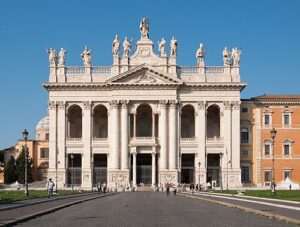
That little phrase is important on this church feast (St. John Lateran Day or our own upcoming parish anniversary this week)—a Body is what we enter into with Christ. He is the Head of the Body, the Church.
He is the House for all nations—we can enter into His cleansing and dwelling place to find refuge and salvation and holiness.
Isaiah 56:7 prophetically describes a day when God will bring Gentiles to Jerusalem, where they will worship him, and he will accept their offerings. Thus, the temple is called “A house of prayer for all the nations” (Isaiah 56:7).
Jesus will make it a fresh start, in His cleansing of the Temple. He even symbolically is standing in the Gentile courtyard of the Temple. Yet the need for sheep, goats, bulls, or pigeons or turtledoves will be ending—for Jesus is the Sacrifice to be offered in Jerusalem for this 33 a.d. Passover. A New Covenant is to be made in and by Him.
The temple was structured as a series of four progressively more holy courtyards. From the outermost to the innermost, they were: 1/ The court of the Gentiles, where Gentiles could come to worship God; in fact, this was by far the largest space in the temple, so they really wanted it to be accessible to Gentiles. 2/ The court of women, where Jewish women could worship. 3/ The court of Israel, where Jewish men could worship, and 4/ The court of priests, where Jewish priests ministered.
John 2:16 (of today’s gospel) has Jesus standing in the marketplace re-make of what was meant to be a holy worship space. He sees all the commerce going on. He commands: “Take these things away; you shall not make my Father’s house a house of trade.”
The point of the account is that Jesus is confronting what is unacceptable to God and He alone has the authority, as Son of God, and Word Incarnate, to say what will be the worthy sacrificial offering and where it shall be done.
As one reads of John 2 or of the other three gospels telling of the Clearing of the Temple, you noted the holy passion going on in what Jesus is doing, contrasting with the unholy anger and hate coming from the chief priests and the scribes who witnessed Jesus doing this Clearing of the Temple. These Jewish authorities acted in great rejection of Jesus’ ministry and claims, and from this moment on “sought a way to destroy him (Mark 11:18).” If you watch the show called The Chosen, then in this season’s portrayal of this Gospel account, you can see this dichotomy.
Yet this Gospel passage is stating: JESUS is the OFFERING. Only His Blood of Offering will be worthy of a clean gift now, as depicted here in today’s Gospel of John 2, with its miracle of wine story connection, foretelling His Blood to be shed. His hour will come, and He will become the cornerstone of a New Temple, that of His Body. He teaches so right here in John 2. Jesus says that His words about the Temple being destroyed will be twisted by the Jews to pose as a threat of Him being the one to topple buildings and start an insurrection. Yet what He meant was that the Jews would act to destroy Him, (and He considered Himself as the New Temple and Body of Believers), but that on the Third Day (referring the time before His Cross Sacrifice and Rising), He would arise from the dead in the great sign of Who He Actually Is.
John 1 is the gospel chapter of the new beginning, as the Alpha/Omega Jesus is among us in the world. John 2 has a woman with a man (a new eve and new adam) and the Man tells the woman in today’s gospel, My Special Hour is coming up ahead. In John’s Gospel, we know now how Jesus was speaking of His New Covenant Sacrifice of His Body and Blood as coming up. John 19 will tell that story of His Sacrifice
Jesus has understanding of the Scriptures and how it is leading to Himself being as “Head of the Body, the Church.” The Psalms had said of the Word of God coming to the world, in enfleshment and of spirit and soul in a Messiah figure. As the writer of Hebrews would sum it up, in our present Catholic theology. Jesus gives us His Body as Sacrifice. A Body Thou has prepared for Me. Hebrews 10:5-. Here this Bible verse in relation to John 2. “Sacrifice and offering You would not have in acceptability of the world’s type of offering, but a body have You prepared for Me: In burnt offerings and sacrifices for sin You have no pleasure in. Then said I, Lo, I come to do thy will, O God, as it is written of Me.”
Now I bring you back full circle to the Lord Who is standing in the first holy area of the Temple, and looking to do away with a marketplace and bring the Cleansing Word of Action to the place.
Final Thoughts
Jesus is Lord of the Church, and He is our High Priest, Prophet, Sacrifice, Word, and much more. This Church Catholic is all about the world, with nearly 2000 years of life back to the 33 ad Rising of Jesus and the gift of Pentecost Spirit in 33 ad—and we are living in His Body and in His Sacrifice. In John 2 is also a story about a BrideGroom and Bride, and Jesus wants the pairing to have a blessed start and fulfillment. It wasn’t just about that Cana couple, but it was about all of us. He can help the Bride be cleansed to be with the Perfect Groom, Our Lord Jesus Himself, if we will let Him be Lord of Love to us. Say Yes. Say Yes in the Holy Mass—the Sacred Liturgy is all about the Mystical Body of Christ, meeting even in our physical place, and asking the Groom to supply us richly with His grace, even His Precious Blood to forgive all our iniquities and failings.