
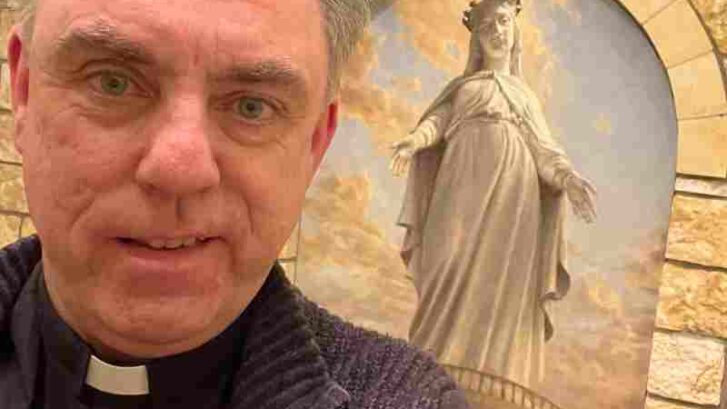
Blind spots for Catholics
Jesus was meeting a man blind since birth, and intending to heal him. Before the actual healing fully happened, Jesus spoke: “While I am in the world, I am the light of the world.” Indeed, He gives physical healings and spiritual ones to give people sight from their blindness. When he had said the declaration of “I Am The Light of the world,” he then went to work on the blind man. Jesus spat on the ground and made clay with the saliva, and smeared the clay on his eyes, and said to him, “Go wash in the Pool of Siloam.” So the man went where he was sent and washed, and came back able to see.’ [John 9]
In this fourth Sunday of Lent Gospel lesson, Jesus is giving the man sight. He also is freeing the man, and his parents, of the insinuation that, if a man was born blind, then he had it coming. He was “bad.” His parents were so-called “bad,” too. This was wrong Jewish theology. Anyway, the man had lived without vision, leaving him to go along in the dark. Until this moment with Jesus, and after the eye treatment, the Lord gave him the duty to carry out for the healing’s completion, and then he became well. Note the two steps. This miracle is similar to the one where a leper was sent to go see the priest for re-entry to society. He had to do a follow-up response to Christ’ healing touch upon him. Jesus works this way sometimes—awaiting our response to what He does. Then a healing comes. Well, this blind man had a very big blind spot! But notice, he was healed. After doing what Jesus asked him to do.
Jesus is still asking people to do things, to get to their healings. But many don’t want to carry it out and do it, they just want instant help with no commitment. So my homily here will be of blind spots in Catholics, which need a disciple to address them in following Jesus’ instructions. Carrying things out. Then, if one is cooperating with the Lord, the healing may come. If we follow the Lordship of Christ. Give the Lord His due respect and your response.
Catholic blind spots–From the viewpoint of a priest.
One is–not recognizing the healing work of Jesus in the Sacrament of Reconciliation. It’s a Blind Spot. Yet the Confession room or place is like the pool of Siloam, where Jesus bids for people to come and get clean of heart and to see better from the heart. How does it work? It is done by one’s following the prompting of the Holy Spirit and living the truth in one’s conscience. If more Catholics would go and do as Christ would ask in this matter, then we’d see more healing.
As a priest, with good news for you, I was happy to give Reconciliation down at Autumn Lake home, the one just 2000 yards from our church towards 29, and it was requested by a faithful Catholic family’s request, so I went to give last rites to a woman on Thursday night: Confession, Communion, and the Extreme Unction. This visit led me next to a resident in the hallway who pulled me aside, and asked if he could desperately have a half-hour of counsel, confession and communion. I gave it to him. He said he was hoping a priest would come down there to Autumn Lake—but we had him not on our list. He said he was not on it because he thought he was unworthy of a lay minister visit. We have Joe and John go down there weekly as lay Eucharistic ministers. I go down when asked to see someone there. The man had told me the gravity of his cause—of not going to Confession or Communion for decades. So he got those Sacraments from me. He has had a marvelous healing, because the Lord put me in the right place and time for him. I would like for you to have such a Sacrament encounter with a priest. But you have to respond to the voice of God in invitation. And act, like the man did. And do what Jesus asks. Last Friday I held confessions for two and a half hours, but maybe for a dozen or so people. The prior Saturday we had the 2nd graders and parents go to Reconciliation. A Wednesday ago I was very pleased at Riderwood to hear two and a half hours in a row of confession. They were great, so there may not be many at
Riderwood living with a blind spot for not respecting the Sacrament of Confession in the church.
Now we go to another blind spot, which are of people not admitting to pride, greed and stubbornness.
Back to the gospel…
When the blind man was healed and going about with eyesight, John 9 says that he was confronted by some Jewish religious authorities, who proudly demanded of him: ‘Who gave you this sight? For only holy men from God like Moses could do such miracles. We are the approvers of any work of God.’ The blind man said: ‘You have physically seen Him, but you don’t want to believe? Why not? Why the stubborn resistance? For me—says the former blind man, why would I not want to get well and see the Lord Messiah?’ But the Gospel says those proud men ‘put him out.’ Yet the healed man comes to realize soon that the Son of Man Messiah was He Who healed him. And those Jews will remain in their blindness, as Jesus teaches everyone about them.
Like people today who let greed and pride control them –can they let Jesus help them? And finally get healed in a repentant heart for their sins? Yet we confessors don’t hear confessions of greed and pride very much. This one priest said: ‘Greed is the most obvious sin and the least confessed.’
I commented to him that a greedy spirit could be underlying cause of the lack of tithing to the church and parish. I label that area of tithing as #1 unconfessed sin, or as I say, a blind spot. Money is spent on all sorts of desires and comforts before one has given to The Lord. The Church belongs to Jesus; anything one gives to Him for His work here would be the humility turn-about to the lust and greed culture out there. What are we building up? I say this for I am concerned about that blind spot that the parish needs a parochial vicar here now, especially since we are hearing news that Fr. Virginus may be gone from here this Summer. A year ago I had the help of him, Fr. DeSiano, and Fr. Beal. By this Summer, three subtractions ahead in a parish that I can’t handle without new help. In 2024 we asked for funds to come in to see if a 6 month guest priest (Fr. Dan) could help us out. Odd as it was, the parish giving went dramatically down in giving in that period. I had to tell the Archbishop we could not afford a parochial vicar. I said the parish has a blind spot regarding my need for help. But we can’t afford to be blind to the need for a new parochial vicar in 2026. I’d like for you to open your eyes and heart to that change ahead.
I can’t put mud and spit on your eyes, like Jesus, but I need the blind spot to be noticed. 11 parishes in Montgomery county already have a parochial vicar, and cooks for feeding the clergy. If I have four priests in the house next July, then we’ll need parishioners to have better open eyes people to see the work that requires a new clergyman here. Surely, I can’t do more than the work of one. I have been creative in opening the rectory to in-resident priests, of Cameroon or Nigerian background. We are glad to have been given their help, to serve some Masses and to full-time cover the hospital.
Yet that transitions me to the last blind spot of Catholics. It’s the lack of vocations support, which also could be lack of priesthood concerns ahead. As we celebrate our upcoming Holy Thursday and the start of the priesthood of the Church in Christ, you must look and wonder of who is coming to help the faithful clergy-wise in the near-future?
We had a sensitive complaint coming from our Riderwood community last weekend, that the African priests coming (t)here were hard to understand, language wise. The sensitive complainers were asking me to do something about it. Like for us to give diction lessons to priests who’ve been in America for over a decade. Well—that’s been already done by them. This is the best they can do.
It made me want to respond to the message in a question: How have you all supported vocations in your life? We priests that have been born in the United States, that have spoken English all of our life, are usually very well understood by our parishioners. Language wise. We are getting less and less in number, as the American parishes have given less home-grown vocations to the Church. For example, Resurrection parish has never given an American born vocation to any religious community or to any diocese— we have zero contributions since 1981. Our Lady’s Poolesville only has us beat by one vocation, Fr. Cwik, in their history. I and my family had a part in supporting his vocation.
Yet without home-grown vocations, meant to be raised up by you, the laity majority, it makes my priestly work (and the Archbishops’) hard—in that most people are non-involved in vocations work. Then, in turn, the parishioners get foreign tongue ‘recruits’ or fill ins who you might have trouble understanding in your parish. But isn’t there a blind spot, that makes people complain instead of answering the Vocations work? The US Church has had to turn to South Korea, Poland, Cameroon or Nigeria or even Oceania to find priests. I have lived and served with all of those five foreign categories in parishes. Because rarely have I had a parochial vicar with me. I’ve had to go looking for extra help, as I did with our clergy here. Thus, you have what the Archbishop (and I) have been given by you as our provided help. And they then serve you. I am glad and grateful to have our clergy here with me. Yet if you want an American priest, then you have to go do the vocations work, which is your going to wash in a Siloam pool. You also have to support a parish to have that extra needed priest.
Three US born vocations are in our 2026 ordination class, by the way, recruited from our 139 parishes, various colleges and workplace situations. Have you been ever involved in vocations support? Did you know, the pastor of St. Raphael’s in Rockville got recruited by his dental patient? The pastor of St. Martin’s in Gaithersburg got recruited by his family, particularly his uncle. The pastor of St. Bernadette’s got the vocations pull due to the Adoration of the Blessed Sacrament, done at his Washington and Lee University (campus ministry), and then he entered after five years at a DC job with Catholic friends he met at St. Matthew’s Cathedral, urging him on.
Many American Catholics have a lack of involvement in vocations. The Church needs priests, but they have taken it for granted that they’re coming in the USA. Yet few parishes are providing seminarians to the call. When I started at St. John the Baptist parish, and started at Our Lady’s, and St. Nicholas, and St. Edward, and St. Aloysius and here—each parish had never given the Archdiocese a priest or a religious life since 1960 to my arrival. (As far as I know.) Not even one person of service given to the Church by any of them. If that isn’t a blind spot, then what would be? We are trying to change that record here. We had a Deacon’s recruitment last Saturday here, and I’m glad how we had all the seminarian cards taken home from Resurrection for prayers for seminarians for Lent. We also are hoping to see former parish member Chike Ugbufoama get ordained as priest. He’s a transitional deacon in Philadelphia now.
What is Jesus is saying to you? “Go and do this for Me.” It’s a big need? Would you head out by My prompting. The blind man did.