
Sunday Gospel: He proposed another parable to them. “The kingdom of heaven is like a mustard seed that a person took and sowed in a field. It is the smallest of all the seeds, yet when full-grown it is the largest of plants. It becomes a large bush, and the ‘birds of the sky come and dwell in its branches.'”
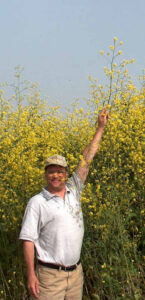 The “mustard seed parable” by Jesus helps us to see that some things that start small can become great. You wouldn’t think that something as tiny as such a seed could lead to a plant growing up, later on, to be as big enough to hold a gathering of birds in its branches. But indeed, in nature, it holds true.
Jesus explains in His teachings and parables that the lessons of nature have many connections to the life of grace. We heard last weekend in the Matthew 13 Parable of the Sower that, naturally, a seed greatly benefits from good soil and deep-enough planting. Likewise, then, the lesson is that a soul that is open to plowing and furrowing and to God’s will can yield “a fruitful harvest, of a hundred fold maybe, or sixty fold, or thirty-fold.” We want that in our spirit-led lives as Catholic. Matthew 13:23 “But the seed sown on rich soil is the one who hears the word and understands it, who indeed bears fruit and yields a hundred or sixty or thirtyfold.”
- Last Sunday, I said that the three stages I saw in my own life and others in the Church, following God’s lessons was to # 1/receive the Word with joy, or else, to pray to get back that excitement #2/ seek understanding with God and His Ways as put forth in the Church, for that gives you depth, but if you are seeding in the shallow ground, then, you are to pray to the Lord to help you delve deeper with Him, so as not to be vulnerable to getting picked off by birds or sun-scorched. #3/ The third stage of the servant disciple is to be one who perseveres in faith— for Jesus says elsewhere in Matthew’s gospel that “He/she who endures to the end will be saved (24:13) ” –or, how “Blessed are you who’ll suffer for My Name and for The Gospel, as in having perseverance, for yours is the kingdom of God.” So, if we aren’t in a persevering mode, then we should pray for it. Or if so, then to help others be encouraged to persevere and to follow Jesus’ “die to self” model. For just as a seed in nature goes into the ground… later on you see from you’re your planting, comes a receiving back. In just weeks later, the mustard seeds are ready to give you a harvest for your yellow, brown or oriental mustard. (Or even for your Dijon brown Grey Poupon mustard from France. Ooh la la! ) ☺
- After a few years, that mustard tree can be 20 feet tall, all from that mustard seed start. From the tiny can come something substantial– a little can become a lot.
In this patriotic year of a 250th anniversary for the USA, I thought of how our own nation began with little, and what seemed ahead to become our own nation, a daunting task. In a Revolutionary times quote, the then-traitor Benedict Arnold gave our budding USA very little chance of survival. His loose quote is thus said; ‘England shall win, I stand with her. We have little to fear of the lowly colonist militias.’ Arnold was confident enough to take a 10,000 pounds bribe and British officer appointment, and to turn over West Point to the enemy British control. This was his lack of consideration of the USA’s chances. You might say that a tiny mustard seed becoming a 20 foot tree would also seem a stretch, but the USA became a large nation, from feeble beginnings but in a heart of freedom.
As our nation, and particularly this area of Maryland, fought the British past its July 4, 1776 declaration—we have stories of the unexpected triumphs that helped us win. When the British fleet was in the Chesapeake in 1813, and ready to bomb St. Michael’s City, there is a fascinating tale of a tree-climbing boy who wanted to be a look-out for the Bay invasion upon them. They’ll attack naturally at night—he guessed. When he was told not to carry a torch up the look-out tree at night, as to give away his position–it led to his idea becoming Militia Leader Benson’s idea of everyone putting out all city lights and instead to be lighting torches in the woods away from the city so as to have it look like a lit-up St. Michael’s City. The fakery worked. The look-outs saw the British fleet come, and they lit up the forest, to seem like a city, and the enemy bombarded that area in mistake for the city, and St. Michael’s was saved. Only a handful of cannonballs hit the town, with no loss of life. The lesson: a simple idea from a boy in a tree led to his saving his town.
A little idea can be a lot when it’s right on the spot.
I have a second story like it. It involved some Maryland youth again. The year again was 1813. General George Armistead was readying for an attack to Fort McHenry. The American troops, he thought, needed a big flag to fly over the city’s defense port, as to say: This land belongs to America now, not you British.
So the leaders of the fort asked a Baltimore woman named Mary Pickersgill and her daughter Caroline, with their all-female flag and garment makers shop, to create such a flag and big statement. They came through. They did it in six weeks. That flag house still stands near Little Italy in Baltimore. The flag remained in the fort, and the British didn’t attack Baltimore until a return trip to the Chesapeake in 1814, with plans now to destroy Fort McHenry and the port and city of Baltimore. Upon a burning of Washington D.C., they came towards Baltimore harbor. The betting odds were all in favor of their 19 well-armed British warships and a large landing party to win this fight. Yet there was a firm determination, grit, and patriotic fervor in Baltimore’s city defenders. The largest stars and stripes flag ever seen flew proudly over the fort. It would help the spirit of those defending Baltimore. It certainly did, and it’s flying through the battle and never falling became the National Anthem song we sing today. 27 fierce hours of bombardment did not force a surrender white flag; the red white and blue prevailed! Today the Smithsonian Museum in DC displays its remnants.
Baltimore also remembers their famous Hampstead Hill land defense that protected the city from the advance of the British soldiers. An amazing win. September 13th and 14th. 1814.
The flagmaker was Mary Pickersgill, who lived with her teen daughter in a brick portside house. Mary had once made a flag for George Washington, as well as had made blankets and uniforms for the Revolutionary troops. Mary and her 13 yr. old daughter Caroline, along with some other women relatives and another 13 yr. old girl (working for the house), are the fairly unsung heroes of that battle, giving the Americans in Baltimore a strong symbol to fight for. Like Moses had his sister Miriam to cheer his spirit on, these women of Baltimore served likewise.
They were given 400 yards of fabric to make a 42 by 30 foot bright flag. Six pointed stars on a blue fabric for the upper left corner, and then the long bright red and white stripes sown together to the massive flag to fly at the fort. The flag had been so big that the shop had to move it to a larger brewery building next door to finish it. It was then completed and taken to Fort McHenry and hoisted up.
If you know the words to the Star Spangled Banner, and its high part lyrics “that our flag was still there, O say can you see?!” –then you can understand the value of this flag, and of, then, the inspired work done by two teens and several women in 1813. It helped win the fight, for the Baltimore defenders had found a lot of endurance for the grueling bombardment. But they borrowed some spirit from the act of these women sewing the Summer before when they made their flag.
Like the story of a seed going in the ground, sown to the earth, but later becoming a 20 foot tree and mustard producer, I think our stories from St. Michael’s Md. and Baltimore port can help us see that a little can produce a lot.
O say can you see, by the dawn’s early light,
What so proudly we hailed at the twilight’s last gleaming,
Whose broad stripes and bright stars through the perilous fight…
Verse 2: What is that which the breeze, o’er the towering steep,
As it fitfully blows, half conceals, half discloses?…
‘Tis the star-spangled banner—O long may it wave
O’er the land of the free and the home of the brave
Verse 4: Praise the power that hath made and preserv’d us a nation!
Then conquer we must, when our cause it is just,
And this be our motto—”In God is our trust,”
And the star-spangled banner in triumph shall wave
O’er the land of the free and the home of the brave