

Featured Sunday reading:
Isaiah 25-6-10
Psalm 96 (Give the Lord glory and honor.)
Give to the LORD, you families of nations, give to the LORD glory and praise;
give to the LORD the glory due his name! Bring gifts, and enter his courts.
Matthew 22: Then they handed him the Roman coin.
He said to them, “Whose image is this and whose inscription?”
They replied, “Caesar’s.” At that he said to them,
“Then repay to Caesar what belongs to Caesar and to God what belongs to God.”
It matters that we pay attention to God’s beautiful things.
Psalm 96 is what we call a royal and enthronement Psalm. It implores us: Give the Lord His due…and enter His ascribed courts with gifts and recognition to God! On earth we have our houses of worship, of which the 98th psalm reminds are little copies of the Heavenly one. The psalm acclaims how “there is strength and beauty residing in God’s sanctuary.” Yet we here below render glory and praise—God’s praise on our lips and in our hearts. It matters that we pay attention to God.
Matthew 22 has people bring him a coin with Caesar’s image on it. He holds the little coin up, indicating that the Roman Emperor of the known world has claims he has made, that imprinted on these coins of the empire is Caesar’s image. Jesus looks at the coin with emphasis on its littleness, before He casts a look up and around at the sky and world—which is God’s. Let Caesar have his little, which he will lose—but you, my friends, give to God the praise He is due, and God will keep all that is His. So say to God: “I am Your possession.” It’s not the money amount but the life and riches of God that is one’s treasure. That is a simple but clear point of today’s gospel.
As you enter into God’s house for a Sunday, I propose that we each bring in with you all the wonderful images of God in nature and all the experiences of beauty that we have gathered up in your heart, mind and soul this week. Bring in honor from your hearts to God—lift it up. We say mid-Mass: “We lift it up to the Lord—for it is right and just.”
As I was a teen, a Psalm line sung often in our St. Pius X church in Bowie was this: “All the earth acclaim the Lord, sing your praise to God.” It was a liturgical sung version of Psalm 100 from a Lucien Deiss. Do you know it still ‘plays’ in my soul? I feel like the beautiful things in life sing to God in nature, like the winds in the trees and into my wind chimes, or the running water off my roof, but even better from a human soul glad to belong to God. In this gospel, I have longed known that the Spirit of Jesus moves us to be praise-making, thankful people of God—it’s God’s receiving time in Holy Mass to receive this love and wonder from us, which is all wrapped in Jesus Christ’ offering made present here. This is a place of encountering God.
In last week’s homily as I preached from the grand image of Isaiah 25 and the Mountain of the Lord of Hosts, I commented that we have wonderful works, even in art, that can help us in God’s house to bring praise. Churches are to try to adorn themselves with connections to the God of all—using art and architecture. In our church, we have use of glass to showcase our God of light, and sky, and colors, and immensity. The ceiling cross of glass is in the shape of a cross, showing the opening God has made via Jesus’ Resurrection. A wall has the Divine Mercy of Jesus image over in an empty space, then further over at the south window it shows us a look at creation, and the north side of church has the colored window with a baptism image flowing down to the fount of new life located there. Look over to the tabernacle, with its room of glass, and with its lamp for the Eucharistic presence, to note a special area, and in front of it are the votive lights of our special everyday prayer intercessions. The flickering red colors and fire are complimented by the wax smell.
O Lord, we give You some praise that is due Your Name. It is not little like a coin, but it is mighty because it is joined to the Sacrifice of Christ Eternal. This is our church to come and meet You and praise You.
On various Masses we go a bit more earthen with lit charcoals and burning incense atop it, putting a fragrance connection to this place of prayer. The wooden pews remind of how most church spaces include this—with kneelers. We also have chairs on our sides for any extra numbers here, too. The carpeting brings a color, as even do the walls. We add a seasonal look with the leaves and trees in the sanctuary. Some Resurrection images greet the church comer in the Commons, bells from the tower play, and an altar lays at the center of attention with the liturgy necessities. All of this is an artistic presentation, and we come and “give the Lord glory and praise” in this house of worship meant for this encounter, in where Jesus invites us to come to Mass.
There is more that can be done in this space. I mentioned this in my pastor’s fall letter, and in last Sunday’s homily, and in bulletin stuffers. In the sanctuary, we have had temporary wall hangings/drapings placed up for many past seasons—but these are worn for wear, ready for a replacement. We could think of a sanctuary painted with a Resurrection image as a next level of using art in this church area. I spoke of how the space around the large crucifix on this back and rounded wall could have a Resurrection
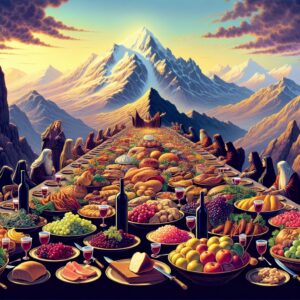 image on it, matching to our parish name and theme. Last week I suggested a type of image like Isaiah 25 could work. A table of rich food and wines, with a host of believers seated with Christ up in the heavenlies. ‘Right?!
I am reminded also of a work in DC’s National Gallery of Art by Edward Hicks on “The Peaceable Kingdom.” It is his rendering of Isaiah 11’s image. This well-known American classic painting with the Lion and Lamb, and a child and other creatures laying down in The Lord’s field of peace tells quite a faith message. I saw it first on an art gallery Christmas card but then in a church reproduction and later the real thing at the NGA. Go see it sometime. Take a long time to gaze upon it—to see what Hicks saw in the Scripture.
Works like this, and if large enough and placed in a church, take the church faithful in prayer to a spiritual gaze.
I am not an artist, but liturgy with art appreciation has turned me into an “apprecianado.“ Last week when a group of us visited an Allentown parish that had its sanctuary all religiously painted at Blessed Sacrament church, I gave a nod to its people—appreciating what they had there. I told them I recognized the strong Jesuit influence of creating warmth and feeling via art in a church. A parishioner was very glad to explain how the painted image has been uplifting him to praise for many years.
“Apprecianado” is a playful, modern portmanteau that blends the English word “appreciate” (to recognize the value or quality of something) with the Spanish-derived suffix “aficionado” (a person who is gets enthusiastic about a particular interest). Can I interest you with guest speakers on Beauty in the House of God to make you fellow apprecianados? (Being fans of praising God via more ways in liturgy.) Liturgical arts has been a part of aiding my prayer life for years. It’s no surprise that I asked for the National Shrine of Mary in DC for a seminary apostolate, so to lead tours in it, and partake in many liturgies in it. But I have looked since to what parishes might do, if on a smaller scale. A parish I was at put up a New Millennia window. Another I was at restored the old tiffany stained glass windows from dark to dazzling. Another began a Nehemiah project of turning a hall into a church. I look back fondly at those beautifying efforts of those parishes. Now I turn to us. It’s starting my ninth year here. We’ve done smaller projects already.
In a church like ours, though, if taking on a big liturgy project of beauty, our renewing the rounded area behind the large crucifix could be the aim, and perhaps we’d have to the image of the Lamb in Heaven and saints in delight there, up atop, and the Risen Christ and His Hope offered to believers to lift them to Glory, by His strong right hand. There below the horizontal cross beam would be the historical Resurrection moments of Scripture, depicted in panorama. Up high on the sanctuary wall could perhaps be the prophesy phrases of Isaiah chapter 40. “Comfort, give comfort to my people, says your God.” “Prepare the way of the LORD!” “For the glory of the LORD shall be revealed, and all flesh shall see it together …” From Mount Zion, Good news! Here is your God! He comes with power.” We could show saints and angels of all types heralding the resurrection of the body and life evermore. A table set for the victorious in Christ. The Lord’s Promise for eternal life are good. That’s an Isaiah 40 image. It’s just one of many possibilities.
So with these comments about art and the church, maybe you can hear today’s gospel lines anew: Jesus is saying to those who wanted to trip Him up on a tax coin question—as in give to Caesar what is Caesar’s, with Jesus opening up His arms to reveal Glory and ask: But why not give to God praise to what is God’s possession? If the world has its coins and signs, then why not seek the greater signs and images of God and His creative power at work in those who believe? He will raise us up on the last day!
Could we make it a greater part of your parish liturgy? Of celebrating our hope and the beauty of the Lord? That’s the parish theme this year.
Could you let me show you more about being drawn into God’s beauty?